
Written by Tatia Okitashvili, Giorgi Kamarauli, Andrina Steiger and Sarah Mark, students from Tbilisi State University and the University of Zurich.
Population and age structures in Switzerland and Georgia are set to change significantly in the future. This demographic change is driven by declining birth rates, large age groups reaching retirement age (for example the "Boomer" generation in both countries), rising life expectancy and growing mobility. Rural regions, especially mountainous municipalities, already feel these trends most strongly in their everyday life and must cope with out-migration and decreasing infrastructure and service availability (Bundesamt für Statistik, 2025; Kohler et al., 2017).
Between 2010 and 2020, the population of Switzerland's mountain regions grew by around 7.5 %, reaching about 2.14 million people (Schweizerische Arbeitsgemeinschaft für die Berggebiete, 2022). This growth, however, is uneven: Some Alpine areas have gained inhabitants, while others, especially parts of the Jura, the Central Alps and remote valleys in Graubünden and Ticino, continue to stagnate or lose population (Keystone-SDA, 2020). Outmigration among young adults remains a persistent concern (Weinfelden24, 2020).
The Covid-19 pandemic temporarily changed these patterns. As more people sought rural living, mountain cantons such as Valais, Graubünden and Uri saw small population increases, while some urban cantons like Basel-Stadt recorded slight declines (Schweizerische Arbeitsgemeinschaft für die Berggebiete, 2022).
A more structural trend is rapid ageing: The share of young people in the mountains has been decreasing for years, while the proportion of older residents has been rising steadily (Keystone-SDA, 2020). Projections suggest that by 2050, cantons such as Graubünden and Ticino could have a majority-elderly population, far above urban levels (Weinfelden24, 2020). This is already visible today in a clearly elevated old-age quotient across mountain municipalities (Schweizerische Arbeitsgemeinschaft für die Berggebiete, 2022).
In Georgia, demographic change is particularly visible in remote mountain regions such as Racha. Since the 1990s many young people have moved to Tbilisi or abroad in search of work and education, while older generations remain in the villages. As a result, the population shrinks and the average age rises, creating what Kohler et al. (2017) call a "demogeographic crisis" in Racha.
Empty houses, closed schools and unused agricultural land are common signs of this trend. At the same time, many households depend on remittances sent by family members working in other countries (GeoStat, 2023).
Local and national actors try to react; for example, by improving roads, promoting guesthouses, and supporting local products such as wine and mountain honey. However, these measures often remain small-scale and cannot fully stop out-migration (Kohler et al., 2017). Without new ideas, basic services like health care, childcare, and transport will become even harder to maintain in sparsely populated valleys. Demographic change therefore affects not only statistics, but also social relationships, local traditions and the emotional attachment people feel to their home villages.
Demographic change especially influences the rural mountain regions of Switzerland and Georgia. Out-migration, declining birthrates and ageing of the population lead to social and structural challenges: Sufficient infrastructure and availability of services for the remaining residents must be ensured. The mountainous regions in both countries are looking for strategies to attract new residents and work against out-migration and ageing trends. Finding new and creative solutions is crucial for keeping the small communities in the mountains alive.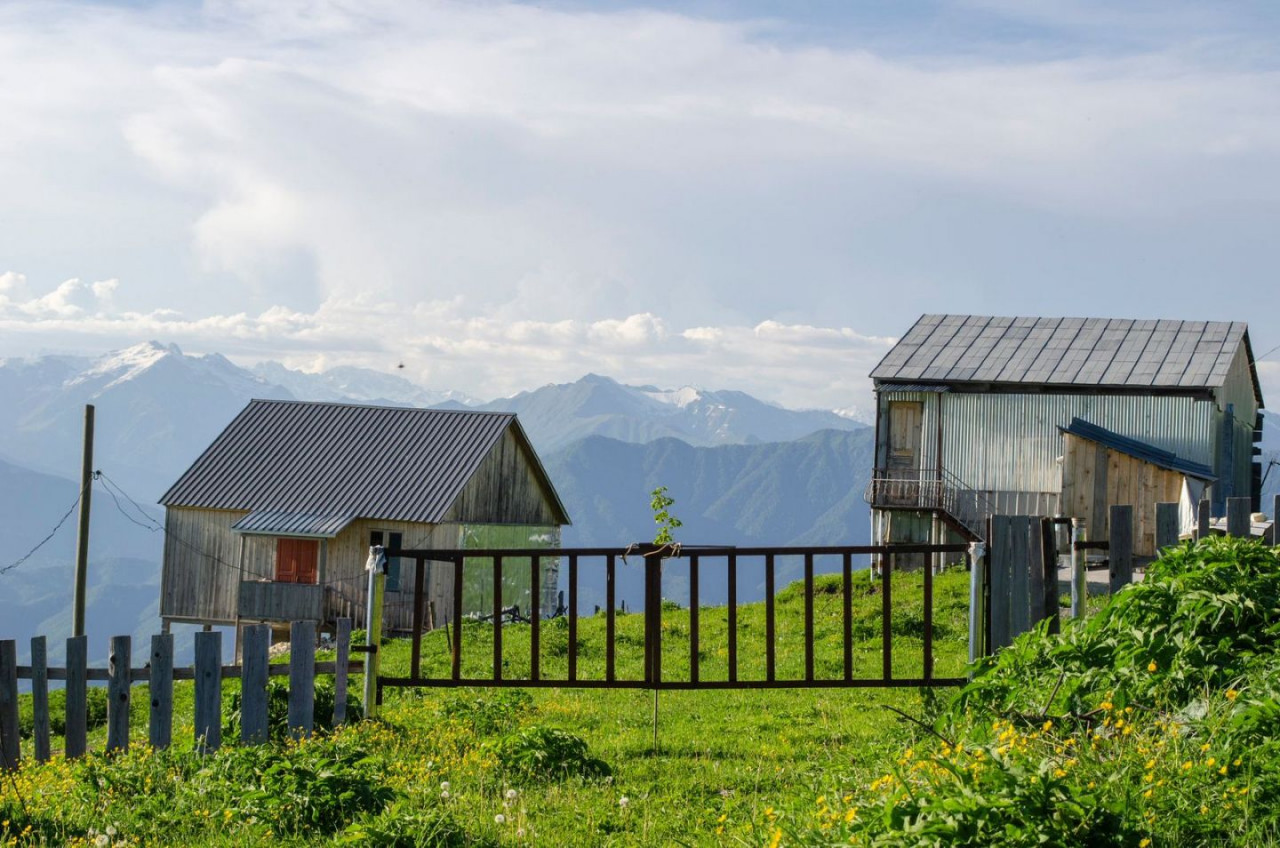
References:
Bundesamt für Statistik. (2025). Schweiz-Szenarien. https://www.bfs.admin.ch/content/bfs/de/home/statistiken/bevoelkerung/zukuenftige-entwicklung/schweiz-szenarien.html. (Accessed: November 21, 2025).
Kohler, T., Elizbarashvili, N., Meladze, G., Scanadze, D. & Meessen, H. (2017) "The Demogeographic Crisis in Racha, Georgia: Depopulation in the Central Caucasus Mountains," Mountain Research and Development, 37(4), p. 415. https://doi.org/10.1659/MRD-JOURNAL-D-17-00064.1.
National Statistics Office of Georgia. (2023). Demographic situation in Georgia 2022. Geostat. Available at: https://www.geostat.ge/en/modules/categories/316/population-and-demography. (Accessed: November 21, 2025).
Schweizerische Arbeitsgemeinschaft für die Berggebiete. (2022). Das Schweizer Berggebiet 2022 – Fakten und Zahlen. https://sab.ch/wp-content/uploads/2022/11/ST253_BIZ_2022.pdf
sda-ats. (2020, July 7). Bevölkerungszuwachs in den Berggebieten. SWI (swissinfo) https://www.swissinfo.ch/ger/bevoelkerungszuwachs-in-den-berggebieten/45886848
Weinfelden24 (2020). Berggebiete überaltern zusehends. https://weinfelden24.ch/articles/16245-berggebiete-ueberaltern-zusehends