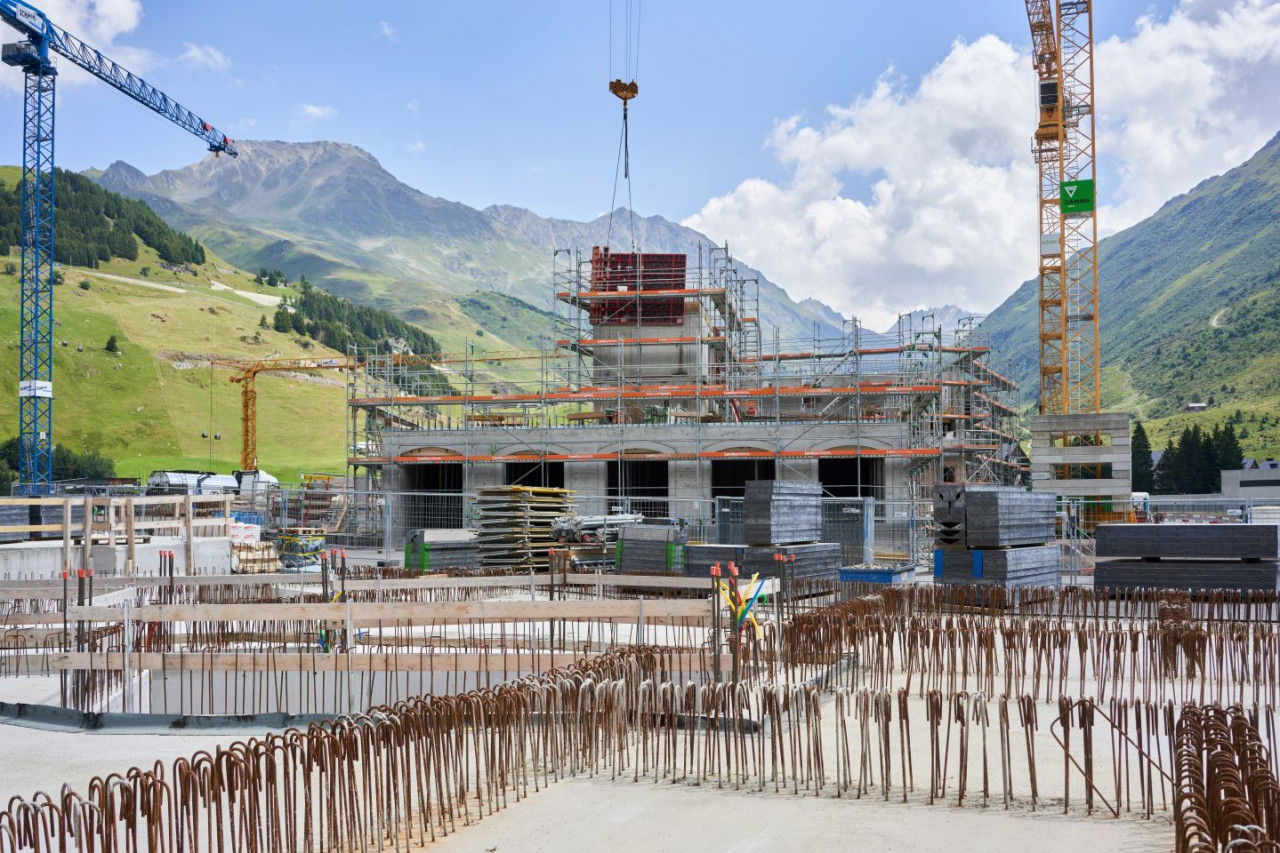
 Construction site in Andermatt, Switzerland. Source: Steffen Lemmerzahl 2022, Unsplash. https://unsplash.com/de/fotos/eine-baustelle-mit-kranen-und-ein-gebaude-im-bau-jmWFNK7ZvbY
Written by Sopka Jighauri, Salome Melkadze, Livia Eckert and Sofia Niggli, students from the Tbilisi State University and the University of Zurich.
Over the course of the last years, there has been an increased interest in tourism in mountain areas (Liu et al., 2022). This is associated with subsequent tourism-related livelihood shifts (Salukvadze and Backhaus, 2020). This blog post examines how tourism-related changes shape and influence the identity of mountain communities in Tusheti (Georgia) and Andermatt (Switzerland) and to what extent these changes differ or resemble each other.
Let us first zoom in to Tusheti in the northeastern region of Georgia. Here, tourism has revived traditional tush practices such as cheese production, wool weaving, and horseback guiding by presenting them to travelers. Seasonal ecotourism has generated income, revived traditional crafts, and encouraged community-based hospitality practices (Gugushvili et al., 2019). Moreover, tourism development in Tusheti highlights its role in protecting nature. In combination, visitor numbers rose from 13,793 in 2016 to 17,153 in 2024 (National Statistics Office of Georgia, 2016; National Statistics Office of Georgia, 2024). As tourism in Tusheti gradually develops, it stays closely tied to local traditions thereby creating economic and nature-based opportunities and keeping a sense of continuity and shared identity.
In Switzerland, Andermatt is an example of how large-scale tourism development can change the identity of a mountain community through rising living costs and contribute to social divisions, causing parts of the village to feel socially and culturally isolated within a short period of time. Since the project began in 2007, an Egyptian entrepreneur has invested around 1.5 billion Swiss francs into new hotels, apartment buildings, a golf course, concert hall and the expansion of the ski area (Andermatt Swiss Alps, 2024). These changes turned the village in the Swiss alps into a world-class destination, boosting the economy and creating new jobs. At the same time, it increased the cost of living and contributed to social divisions within the local population. A study notes that the traditional village and the newly built resort area feel like two separate worlds to some residents (Durrer Eggerschwiler et al., 2021).
Comparing Tusheti and Andermatt shows how tourism development reshapes the identities of mountain communities in different ways. On the one hand, Tusheti's tourism grows slowly and is community-driven, helping revive traditional practices and strengthening cultural continuity (National Statistics Office of Georgia, 2016; National Statistics Office of Georgia, 2024). Competitive advantage of the mountainous destinations creates additional socioeconomic benefits, for example loyal visitors, while retaining the long-standing cultural identity of the host community (Gugushvili et al., 2019).
On the other hand, Andermatt's transformation is rapid and investor-led, with large scale luxury projects reshaping the village into a modern resort (Andermatt Swiss Alps, 2024). As these changes unfold, some residents feel a divide between the historic village and the new tourist area (Durrer Eggerschwiler et al., 2021).
Studies focusing on place identity theories, report that it is a multidimensional concept with a variety in taxonomies (Liu et al., 2022: 4). For instance, applying Breakwell's four-dimensional concept (distinctiveness, continuity, self-efficacy, and self-esteem), we observe that Tusheti's identity is strengthened more homogeneously on all dimensions, while Andermatt's identity is changing more ambivalently. For example, on the self-efficacy axis social and cultural divisions are emerging. (Liu et al., 2022: 15) In summary, the main differences between the Tusheti and Andermatt cases are scale, pace and direction. Overall, tourism preserves identity in Tusheti, while in Andermatt it creates social and cultural gaps thereby having a more transformative impact on the place identity. Taken together, these examples illustrate that tourism can support or challenge local identity on various dimensions.
References:
Andermatt Swiss Alps (2024). Increase in property sales revenue at Andermatt Swiss Alps – net profit achieved for the first time in 2023. https://corporate.andermatt-swissalps.ch/en/news/increase-in-property-sales-revenue-at-andermatt-swiss-alps-net-profit
Durrer Eggerschwiler, B., Näther, C., Egli, H., & Lienhard, M. (2021). Langzeit- und Begleitstudie BESTandermatt: "Soziokulturelle und sozioökonomische Auswirkungen des Tourismusresort Andermatt" Schlussbericht der 4. Teilstudie. Hochschule Luzern - Soziale Arbeit. https://doi.org/10.5281/zenodo.5638981
Gugushvili, T., Salukvadze, G. & Salukvadze J. (2019). Has traditional Georgian hospitality been sustained under tourism development? Evidence from the high-mountain regions of Georgia. Mountain Research and Development, 39(4). https://doi.org/10.1659/MRD-JOURNAL-D-19-00011.1
Liu, Y., He, J., Chen, Q., Fu, B., & Dong, E. (2022). Mountain outdoor tourism and tibetan mountain guides' place identity: The case of mt. Siguniang town. Sustainability, 14(22), 14926. https://doi.org/10.3390/su142214926
Salukvadze, G., & Backhaus, N. (2020). Is tourism the beginning or the end? Livelihoods of georgian mountain people at stake. Mountain Research and Development, 40(1). https://doi.org/10.1659/MRD-JOURNAL-D-19-00078.1
National Statistics Office of Georgia. (2016). Tourism statistics: Tusheti region 2016. GNTA. https://api.gnta.ge/storage/files/doc/geo-turizmi-2016.pdf (accessed 30.11.25).
National Statistics Office of Georgia. (2024). Tourism statistics: Tusheti region 2024. GNTA. https://api.gnta.ge/storage/files/doc/saqartvelos-turizmis-statistikuri-mimokhilva2024.pdf (accessed 30.11.25).
Zubitashvili, T. (2023). Tusheti - the heart of Georgian tourism. American Journal of Social and Humanitarian Research, 4(7), 19–22. https://doi.org/10.31150/ajshr.v4i7.2345