 Swiss mountain village (https://www.foyerglobalhealth.com/wp-content/uploads/2022/04/Sexpatrier-en-Suisse-notre-guide-pour-une-installation-reussie.jpg)
Written by Giorgi Bachiashvili, Lauma Goldmann and Lea Buchmann, students from Tbilisi State University and the University of Zurich.
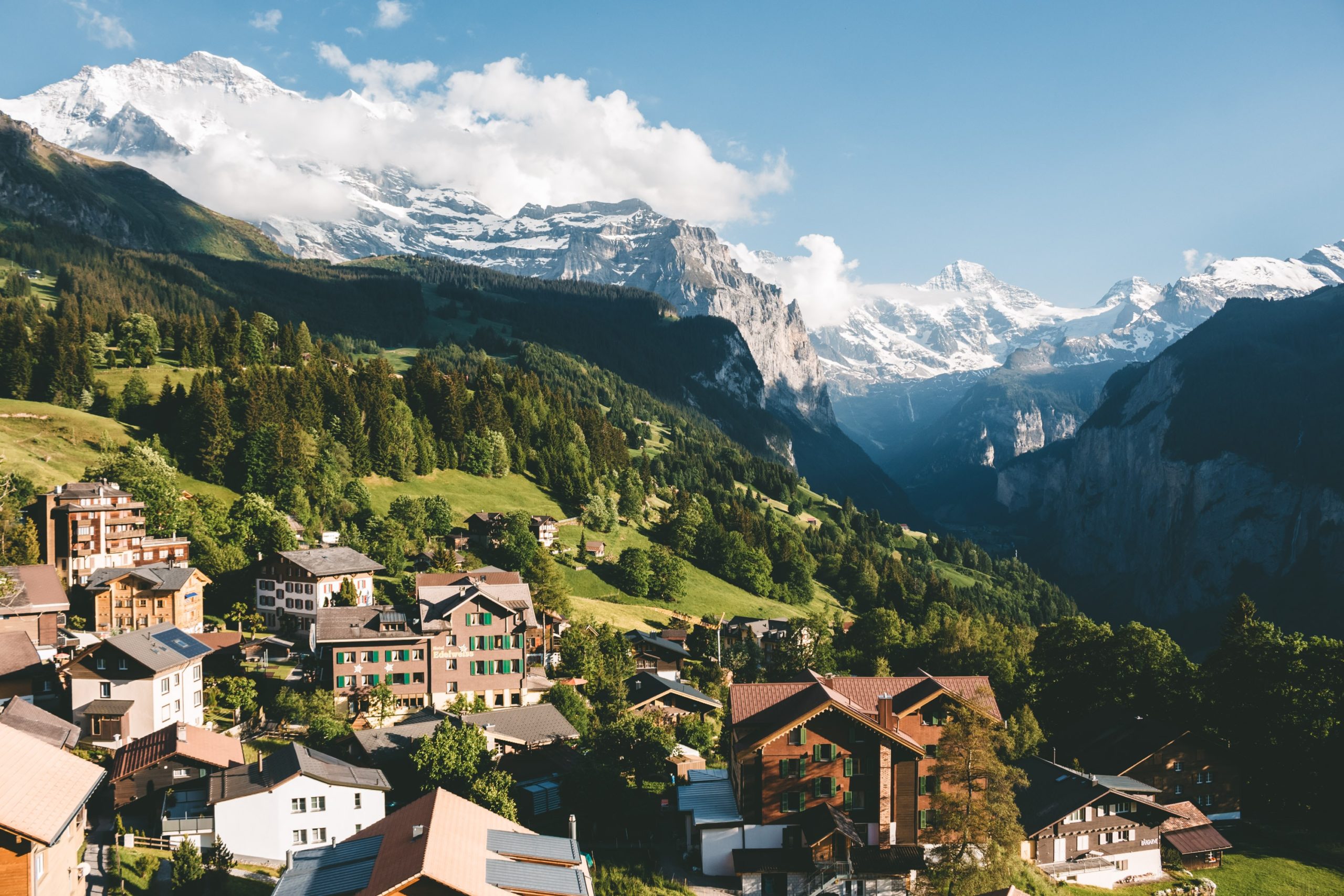
Migration from mountain regions refers to the movement of people from high-altitude areas towards lowland cities (Camenisch & Debarbieux, 2011). In Switzerland, this trend is highly relevant, as a large part is covered by the Alps and due to demographic challenges faced by many mountain communities: population decline and aging demographic structures (Alpine Convention, 2015). Understanding these spatial patterns and their implications is essential for addressing regional inequalities. This blogpost will explore how structural change and economic pressure shape out-migration from mountains in the Swiss Alps by drawing on insights from recent research (Perlik, 2011).
In Swiss Alps, it becomes visible how there is both out-migration and rapid population ageing, particularly in mountain municipalities (FSO, 2025). When looking at the history of mountain areas, we can see the dependence on small-scale agriculture, seasonal work and increased tourism (Alpine Convention, 2015). The ongoing change towards the tertiary and quaternary sector take place in urban lowland areas, creating an additional factor of separation between the regions. As Camenisch and Debarbieux (2011) argued, a distinctive "mountain factor" shapes inter-communal migration. This concept captures how mountain communities lose their residents to centres, which are better connected and provide better prospects in terms of professional development (Camenisch & Debarbieux, 2011).
Economic pressure and structural change strongly influence migration from Swiss mountain regions. Perlik (2011) argues that traditional notions of permanent relocation are no longer sufficient. Instead migration is mainly "amenity-led" (Perlik, 2011: 1) and shaped by mobility and as Nelson (2006) notes due to failed social networks. Many newcomers are "multi-locals" who reside in the cities but maintain second or third homes in the mountains. This contributes to rising housing costs and gentrification. Camenisch and Debarbieux (2011) distinguish between "cold" and "warm" communes. Cold communes exhibit low emigration and limited demographic shifts, while warm communes experience high in- and out-migration. This highlights a broader imbalance as some villages continue to lose residents while others gain them. Most migration occurs within the same geographic zone, mountain villages to other mountainous villages instead of to the Swiss Plateau, termed "the mountain factor" (Camenisch & Debarbieux, 2011: 13). However, even in warm communes, population growth does not guarantee long-term sustainability, since newcomers remain only for a short time.
As ageing alpine communities coincide with rising out-migration, the demographic will change rapidly in the future. Many young people, who leave "cold" mountain communes in search for better employment, leave behind a community of older people, weakening local economies. As Pelik (2011) mentions, productive economies risk being replaced by consumption-driven, seasonal ones. Furthermore, the distinct local identity can be diluted, if the number of multi-locals increases and the amount of local people declines.
To ease migration pressures from mountain areas, policymakers should promote local jobs, improve infrastructure, and support mountain households. Strengthening social and economic opportunities, through education, health, and small-scale businesses, helps people build livelihoods without leaving. Such approaches reduce distress migration, foster sustainable mountain development, and allow residents to stay while improving their well-being. Migration from the Swiss Alps shows mountain communities under pressure. Without action, some areas will age and weaken. But with better jobs, services, and opportunities, residents could stay, livelihoods could improve, and the unique identity of these mountain communities could survive for the future.References:
Alpine Convention. (2015). Demographic Changes in the Alps: Report on the State of the Alps. https://www.alpconv.org/fileadmin/user_upload/Publications/RSA/RSA5_EN.pdf
Camenisch, M., & Debarbieux, B. (2011). Inter-communal migrations in Switzerland: A 'mountain factor'? Journal of Alpine Research | Revue de Géographie Alpine, 99–1. doi: 10.4000/rga.1368
FSO. (2025). National projections. Federal Statistic Office. https://www.bfs.admin.ch/content/bfs/en/home/statistics/population/population-projections/national-projections.html
P.B Nelson. (2006). Geographic perspective on amenity migration across the USA: national-, regional- and local-scale analysis. In The amenity migrants: Seeking and sustaining mountains and their cultures (pp. 55–72). CABI.
Perlik, M. (2011). Alpine gentrification: The mountain village as a metropolitan neighbourhood. Revue de Géographie Alpine, 99, 1–13. https://doi.org/10.4000/rga.1370
Bachmann, Felicitas & Maharjan, Amina & Thieme, Susan & Fleiner, Renate & Dach, Susanne. (2019). Migration and Sustainable Mountain Development: Turning Challenges into Opportunities